by Karen Siegemund and Bradley A. Thayer
As the Russo-Ukrainian war continues, Americans may blame Russian leader Vladimir Putin for starting “World War III.” It is correct that World War III has started, but its cause is the People’s Republic of China (PRC), not Russia.
The war did not start with Putin’s invasion of Ukraine in 2022 or with the appeasement of Russia in the years before Putin’s foolish aggression. It started with the Chinese Communist Party (CCP). The CCP has been at war with the U.S. since coming to power in 1949 and has employed many fronts in this war to undermine America and the West. The CCP’s May 2019 declaration of “People’s War” against the U.S. was CCP leader Xi Jinping’s call for a maximal effort against America. Not coincidentally, the COVID-19 outbreak soon followed. The CCP lied about COVID’s origins, refused to share information with the world, and used Tedros Adhanom Ghebreyesus, the director-general of the World Health Organization (WHO), as its willing accomplice. Another front is CCP election interference.
President Trump has revealed the CCP’s interference in the 2020 U.S. presidential election in an effort to secure President Joe Biden’s victory. Biden’s open borders allowed many hundreds of thousands of military-age Chinese men into the United States—prepositioning a force to strike against the American people in their homeland. The sustained chemical warfare attack that is fentanyl is another avenue of attack, destroying American lives and families. The CCP’s success at buying American and European politicians and journalists to serve as its agents of influence is yet another, as is TikTok.
Putin is not the source of World War III. Putin is, in the scheme of World War III, a secondary player. It is Xi who is driving World War III. It seems that the common denominator for every manifestation of this global crisis, whether overt or covert, foreign or domestic, is that Xi Jinping and his CCP have either inspired or enabled them—or at least, stand to be the principal beneficiaries. Consequently, while some call this World War III, one might consider a more apt name to be “World War Xi.”
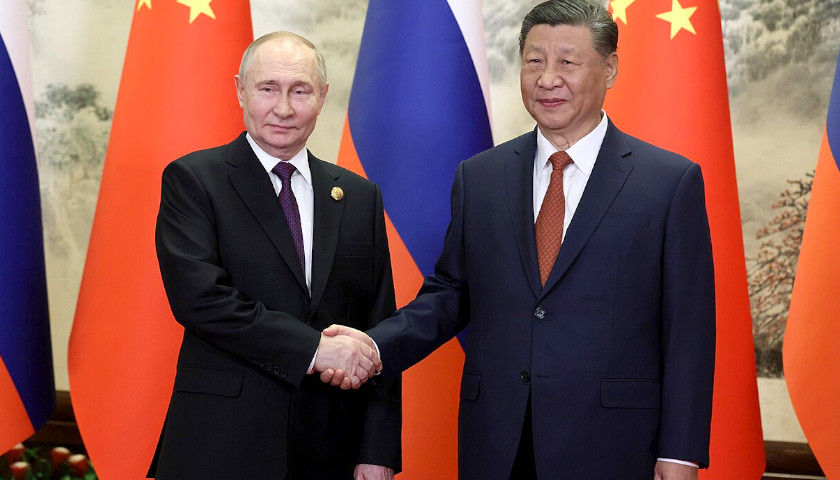
It was Xi who gave the green light to Putin to invade Ukraine when they met in early February 2022. Xi and Putin have met over 11 times since then, most recently in Bishkek, and on each occasion, Xi has evinced strong, public support for Putin’s war. While the Russo-Ukrainian war is not yet resolved—it has lasted longer than World War I—it already has a clear winner: the PRC. The PRC provides great assistance to Russia—diplomatic, economic, and “dual-use” military aid—all of which is important to sustain Russia’s war. Beijing is receiving a prodigious return that is helping Xi win World War III.
First, by sustaining the war, the PRC occupies the U.S. and so diverts attention from its aggressive acts and preparations for war over Taiwan, which might include attacks against the U.S. itself. The U.S. intelligence community and military have only so much bandwidth, and the conflicts in Iran, Ukraine, and elsewhere in the Middle East are filling it. In addition, U.S. stockpiles are drained by the conflict in Iran and aid to Ukraine, including Patriot, ATACMS, and other missiles, and 155mm artillery rounds, all of which reduce the ability of the U.S. military to fight a high-intensity war with the PRC. In turn, a reduced U.S. arsenal hurts U.S. conventional deterrence in key theaters, like the western Pacific and Taiwan.
Second, the war cements Putin’s dependence on the PRC. Putin is Xi’s myrmidon, the supplicant in the relationship. Truly, Putin is Xi’s useful idiot. Xi drafted Putin to serve in his anti-Western alliance, which costs Putin his autonomy. Xi’s ultimate ambition is to overthrow U.S. power and position in the world and shackle the world to the PRC’s tyrannical ambitions. Putin’s interest would have been better served by emerging as the tertius gaudens of the conflict between the U.S. and the PRC. Now that he has tied Russia’s interests to the PRC, he will walk the path Xi requires of him. That requires Russia to accept diminished influence when Russia’s interests conflict with the PRC, such as in Central Asia, and to serve as an instrument of distraction for the U.S. and its NATO allies while China expands its military power and strategic ambitions. Putin must fear that once he has served his usefulness, Xi may overthrow him.
Third, Putin also serves as a lightning rod, attracting the world’s animus and attention for his acts while Xi’s genocide in Xinjiang remains too often unremarked and in the background. The PRC’s preparations for war against Taiwan and its increasingly coercive measures against the Philippines also do not receive the attention they deserve.
Fourth, as a result of the Ukraine war, Xi has secured his northern flank. Russian conventional and nuclear military power is now a tool to be employed in conjunction with or apart from the PRC’s military—but to serve Beijing’s interests. The U.S. has a “multiple front” war problem with which it must contend.
Moreover, Xi has secured his western flank in Central Asia. The Central Asian states perceive Russia as a threat due to the invasion of Ukraine and see Moscow as the junior partner in the Sino-Russian relationship. For Xi, this is a remarkable occurrence at the same time that China is committing genocide against Kazakh, Kyrgyz, and Uyghur Muslims in Xinjiang or East Turkistan. The PRC’s western flank is as secure as it has been in recent years. With two flanks secure and Xi’s ability to project power expanding, it is no surprise that Xi is aggressing on the PRC’s southern and eastern flanks.
The bottom line is that the Russo-Ukrainian war greatly benefits the PRC. As the PRC gains in military might, this hurts the ability of the U.S. to defend its national security interests elsewhere, including in the western Pacific. In turn, this weakens the ability of the U.S. to deter aggression against Taiwan, the Philippines, and other states, as well as the ability to fight a war with the PRC, should deterrence fail.
The costs of the Russo-Ukrainian war are high in every respect. While Moscow may eke out a Pyrrhic victory, the true winner of the war is Beijing. The war continues because Xi wants it to, and his aid allows Putin to pursue his folly.
With its strategic position strengthened and its power projection capabilities expanding, the PRC is putting in place the conditions necessary for aggression. The U.S. and its allies should expect China to center its belligerency on its southern and eastern flanks. This aggression might be kinetic—indeed, at some point it will be so—against India on Beijing’s southern flank, against Taiwan on the eastern, and possibly even against Japan and the U.S. But the PRC will continue to employ all the tools of statecraft to bring its might to bear to cause the change it wants. Thus, the world should expect diplomatic, ideological, and economic pressure to be employed by the PRC against them, while Beijing also seeks to undermine the governments of India, Taiwan, Japan, and the U.S. We should also anticipate the continued expansion of the PRC’s domestic influence in those countries through the use of the PRC’s United Front Work Department to subvert them and other overt and covert efforts.
It is a new world. Soviet dominance over the PRC during the Cold War is now reversed. In World War III, the PRC calls the shots because of Putin’s strategic idiocy. Having the PRC’s northern and western flanks secured is a key step toward Xi’s greater belligerence. The CCP is employing many tools in this war, and the American people need to recognize the avenues of attack. The U.S., its allies, and its partners must move beyond anticipating aggression to recognizing its certainty and the reality of World War Xi.
– – –
Dr. Karen Sigemund is president of the American Freedom Alliance, where Dr. Bradley A. Thayer is a Fellow and author of America’s 100 Years’ War: How to Win Against Communism.
Photo “Xi Jinping and Vladimir Putin” by Kremlin.ru. CC BY 4.0.